Knitting machine residency
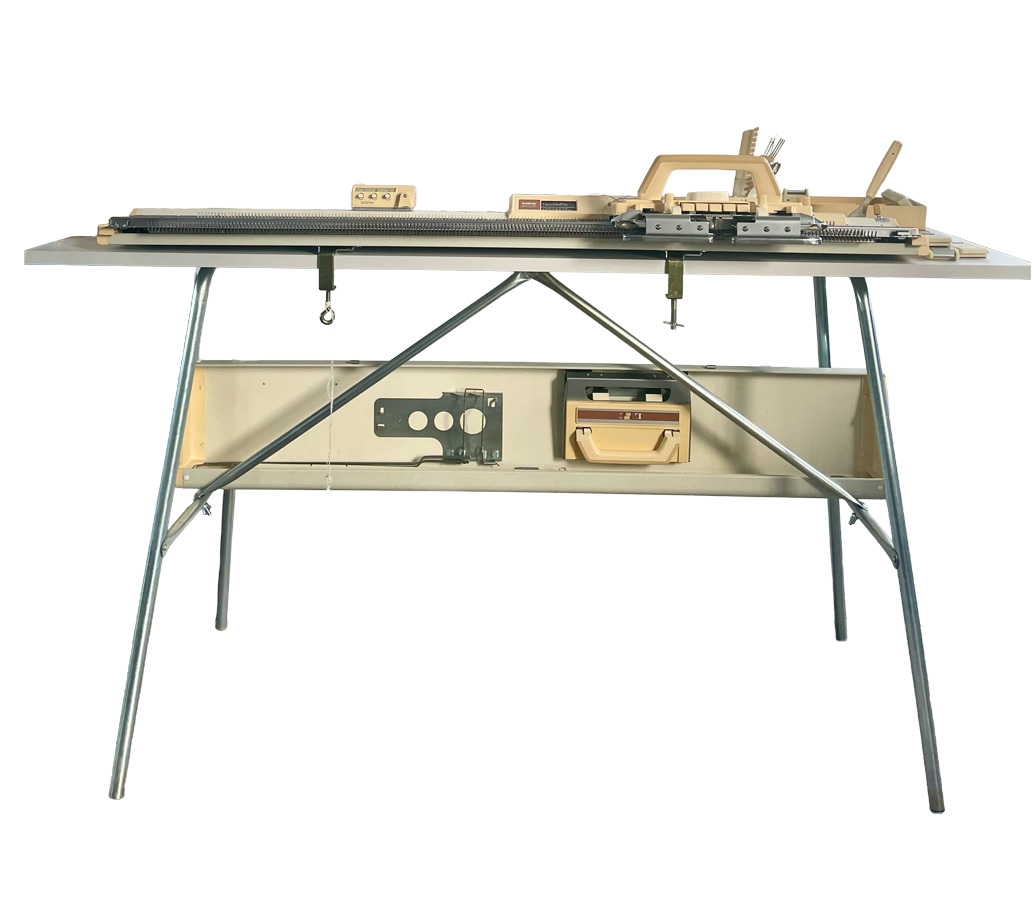
My knitting machine
Over the months of March until May I was a resident at Ceola and Maurik’s studio. I really wanted to learn how to knit on my hand-powered knitting machine. I bought my Brother KH710 back in 2023, but never found the time and space to properly get into it, and this was my chance.
Domestic knitting machines such as the one I have were really popular during the 1950s through the 1980s. The machines became a massive household trend following World War II. It allowed families to make affordable clothing at home, and a lot faster than when knitting by hand.
My machine consists out of a bed with 200 knitting needles, a carriage that rides across (and knits) those needles, and lots of tools to be able to work with the needles, to make patterns, to bind off etc.
When I started with the residency I really wanted to learn how to knit a garment, something that I could wear. I wanted to understand what shapes make up a jumper or a vest, how to knit those shapes and how to connect them together.
Making something on a knitting machine requires a lot of planning and forethought. Rather than cutting shapes out of fabric, you need to knit the fabric in the particular shape(s) that you want.
My residency was not only about learning to operate the machine and the knitting itself but also about how to draft a pattern that can be knitted. So how to translate a design to measurements, and then to stitches and rows (which is what makes up a knitted garment). There was a lot of maths involved in the process, but it was also really fun to see my calculations turn into fabric, and finally into something 3D that I could wear.
Throughout the weeks/months I worked on just one piece, a vest, with rolled edges for the bottom and neckline, and a 1x1 rib trim at the armholes.
More